


Ani Lee is a 26-year-old graphic designer living in Long Island, New York. As a young Chinese American creative, she would love to someday redesign a traditional Chinese object using her own unique perspective.
Meanwhile, today, she is still finding ways to explore her cultural heritage, from collecting Lunar New Years hong bao (red envelopes) to celebrating Mooncake Festival with her close family members.
Read our conversation with Ani below.
The following interview has been edited for length and clarity.
Growing Up
When did your family arrive in America?
From 1963, my dad grew up in Chinatown, Queens, NY. My mom was originally born in Taiwan, then moved to the Philippines when she was 10 years old. Then at age 15, she moved to Queens, New York. After my parents got married, they moved to Long Island.
What was it like growing up between two cultures?
When I was younger, I went to a Chinese pre-school in Queens. I spoke fluent Mandarin, which is very different from how I am right now. I was shy as a kid, but was still very comfortable speaking Mandarin and getting to know the kids in my class.
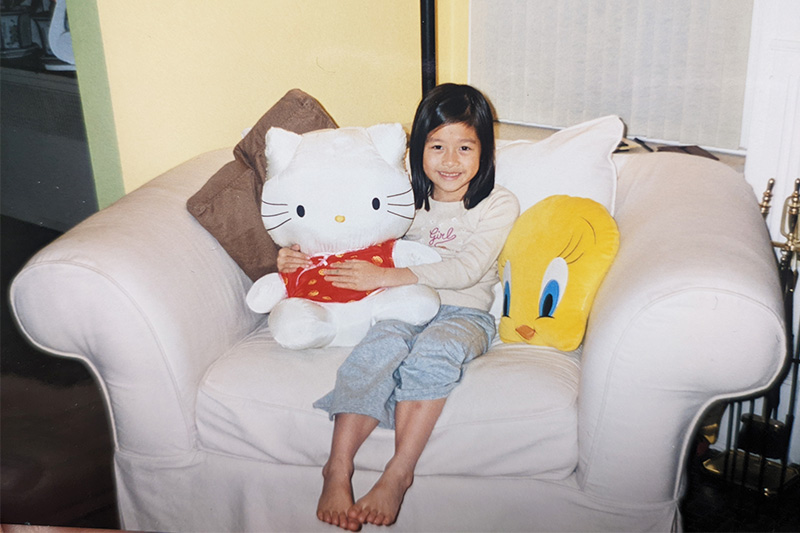
Then suddenly, I had a quick transition to an English-speaking school. The only people who would grandparents went on vacation for a couple of months. Since they were the only ones who would normally speak Mandarin with me, I started speaking only English.
At school, when I would describe things that my mom would listen to or watch, like Mandarin pop or Chinese dramas, everyone would look at me and say, “I don’t know what that is.”
Those were the small instances where I would think, oh I’m a little different.
Cultural Identity
Was there a certain point where you felt more confident in your identity?
Once I started college, there were a lot more people I could reach out to. I attended FIT for four years, which was in the city with a huge group of diverse people. That was the time I became confident in who I was, and in my culture.
When I talked about my memories, my favorite pop bands, my favorite K-Pop bands, my friends were actually familiar with them. We would share music videos and go down memory lane together. We also talked about mental illness, and other taboo topics that weren’t talked about in Asian households.
That’s when I felt like I truly belonged.
Aside from our shared backgrounds, our openness in actively confiding in each other about our childhood struggles consoled me in more ways than one. It made me think, ah, I’m not alone after all.
Holidays & Traditions
Are there any cultural traditions that you would like to pass down?
The most obvious one is Lunar New Year. We would always get the family together– that’s the staple of any holiday that you want to celebrate.
I would get to see my aunts again, my uncles, my cousins, which was something I was always excited about. We would have traditional Chinese dishes, like Peking Roasted Duck, Hainanese Chicken and Sticky Rice Dumplings (Zongzi), and catch up on everything together. Later, we would hand out the hong bao.

I’ve always been a big fan of astronomy. Every time I used to go outside at night with my mom or dad, I would go, look at the moon, it’s so beautiful!
Even now, when the festival day comes, I always ask my grandparents, are you going to buy the mooncakes? Are you bringing them along? Every time I eat a mooncake, I get this sense of nostalgia. It brings back good memories.
What is an object that you treasure that reminds you of your heritage?
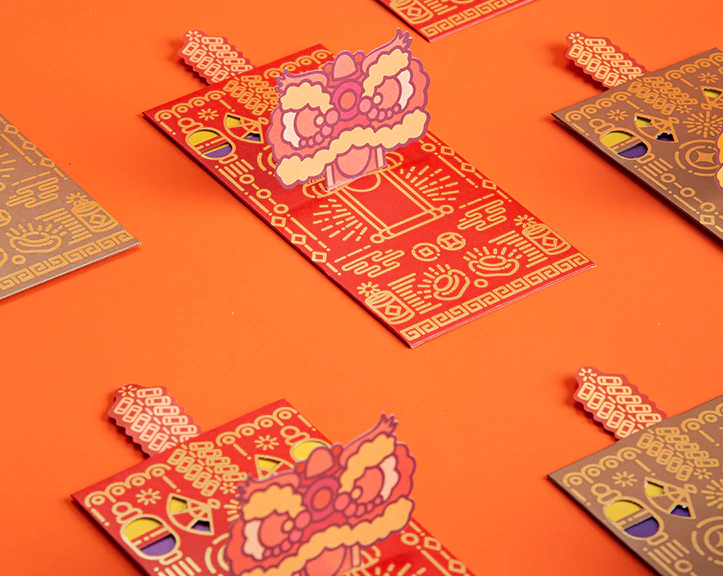
During Chinese New Year, I always keep the hong baos. I just love how decorative they are. Sometimes, people throw them out, but I would keep them for years. I look back on them, even though I personally don’t know how to read them.
I also follow a few artists who incorporate their original characters into their own custom hong bao designs. I love that and want to do that too someday. I think that effort is about weaving your own identity and imagination into the heritage culture that you’ve grown up with.
Expressions & Superpowers
Is there an expression you heard often growing up?
There’s one that I clearly remember. Every time I felt like a failure, like I wasn’t doing well in life, my dad would always say, “there’s a silver lining in every cloud.” This expression has helped me get through a lot of things. Before, when I was a kid, I didn’t believe it.
Now that I’m older, I realize that he has a point. Every time something not so great happens, my dad reminds me that there may be a reason for it. Whether you fail or succeed, there’s always an opportunity.
Lastly, what does being multicultural mean to you?
Being multicultural gives me knowledge and perspective. It might not be the most glamorous or flashy of superpowers, but nevertheless, a resourceful one. You get to witness the way two or more cultures can blend together and interact, and to experience not just a single way of living, but multiple.
And lastly, you have stronger ties to multiple ancestries, languages, foods, traditions, holidays, and etc. I think that is a privilege not everyone can have: a more open mind to diversity.
